Beyond the Label: How Amino Acid Analysis Drives Protein Quality Assessment

In today’s protein-conscious world — from vegan bars and sports supplements to clinical nutrition shakes — quality matters more than just quantity. While most product labels highlight total protein content, not all proteins are nutritionally equal. This is where amino acid analysis becomes a true game-changer: not only revealing how much protein is present, but how valuable it is for human nutrition.
At Envirocare Labs, we offer high-precision amino acid profiling — the critical first step in evaluating protein quality. Although we do not directly measure digestibility, our comprehensive amino acid analysis data can be paired with established digestibility coefficients, such as those in the FAO/WHO (2013) guidelines, to calculate meaningful protein quality scores. For other food sources, digestibility values may be drawn from scientific literature or generated through specialized studies.
But what exactly is protein quality — and why does it matter?
What is Protein Quality?
Protein quality refers to a protein’s ability to deliver all nine essential amino acids (EAAs) — in the right proportions and in a form your body can digest and absorb efficiently.
These nine EAAs — histidine, isoleucine, leucine, lysine, methionine, phenylalanine, threonine, tryptophan, and valine — are considered “essential” because the human body cannot produce them and must obtain them through food.
To determine protein quality, scientists consider two main factors:
- Amino Acid Composition — whether the protein contains all 9 EAAs in amounts that meet or exceed the human requirement pattern (e.g., FAO/WHO 2013 reference).
- Digestibility — how well the protein can be broken down and absorbed in the digestive tract, which may be affected by processing and antinutritional factors like phytates or tannins.
These two components are combined into a measurable value called the Protein Quality Score, calculated as:
Protein Quality Score = Amino acid Score (AAS) × Digestibility Coefficient
- The Amino Acid Score (AAS) compares the amount of the limiting essential amino acid in the test protein to a reference protein.
- The Digestibility Coefficient reflects the percentage of the protein that the body can absorb and use.
This score helps distinguish nutritionally complete proteins from those that are high in quantity but lack the quality required for optimal health.
Interpreting the Protein Quality Score
Once the Protein Quality Score is calculated, it reveals how effectively a protein supports human nutrition. A high score indicates the protein contains all nine essential amino acids in the right proportions and is easily digested — making it ideal for supporting growth, immune function, and tissue repair.
On the other hand, a low score may indicate a deficiency in one or more EAAs — known as limiting amino acids — or poor digestibility due to antinutritional factors or food processing.
- Proteins with these limitations are considered poor-quality proteins, and may lead to nutritional gaps, especially in plant-based diets or during clinical recovery.
- Understanding the difference between high- and poor-quality proteins helps you make better choices for nutritional adequacy, not just protein quantity.
However, digestibility — the other half of the equation — must also be considered. It can be influenced by antinutritional factors (like phytates, tannins, or enzyme inhibitors) and processing methods (like heating, fermentation, or extrusion). For a true understanding of protein quality, both the amino acid profile and digestibility need to be assessed.
From Lab Data to Label Claims
While amino acid analysis is a powerful scientific tool, its value extends far beyond the lab. In everyday life, consumers don’t see amino acid breakdowns — they rely on bold marketing claims like “High Protein” stamped on packaging.
This creates a disconnect between scientific evaluation and consumer understanding. Just because a food claims to be “high in protein” doesn’t mean it delivers high-quality nutrition.
High Protein….But High Quality?
Today, it’s common to see “High Protein” on labels for cereals, shakes, snack bars, and even desserts. But these claims usually refer to quantity, not quality.
Just because a product lists 20 grams of protein doesn’t mean your body can fully absorb or benefit from it. What truly matters is:
- Does it contain all 9 essential amino acids?
- Are they present in proportions aligned with human needs?
- Is the protein digestible and bioavailable?
If the answer to any of these is no, then the product might be protein-rich on paper, but nutritionally incomplete in practice.
So, before you reach for that protein bar, ask yourself:
“Is it just protein-packed… or actually protein-smart?”
That’s where scientific tools like PDCAAS (Protein Digestibility-Corrected Amino Acid Score) and DIAAS (Digestible Indispensable Amino Acid Score) come in — evaluating not just how much protein you’re consuming, but how much your body can use.
Meet the Judges: PDCAAS and DIAAS
To scientifically evaluate protein quality, two globally recognized scoring systems are used: PDCAAS and DIAAS. These “judges” help determine not just how much protein a food contains, but how much of that protein your body can actually use.
1. PDCAAS (Protein Digestibility-Corrected Amino Acid Score)
PDCAAS is one of the most widely used methods for evaluating protein quality. It is calculated using the following formula:
PDCAAS = Amino Acid Score (AAS) × True Fecal Digestibility
To determine the score, the protein’s amino acid profile is compared to the FAO/WHO 2013 reference pattern. The limiting amino acid (the essential amino acid present in the lowest proportion relative to human needs) determines the AAS. This is then multiplied by the protein’s total fecal digestibility to yield the final PDCAAS value.
- Score Range: 0.0 to 1.0
A score of 1.0 indicates excellent protein quality.
Scores above 1.0 are capped at 1.0.
PDCAAS is widely used in food labeling regulations, including by the FDA (USA) and Codex Alimentarius. It may overestimate actual amino acid absorption, since it doesn’t account for microbial activity in the colon — making it less accurate for plant-based or processed proteins. This limitation led to the development of a more accurate method: DIAAS.
2. DIAAS (Digestible Indispensable Amino Acid Score)
DIAAS is a modern and scientifically advanced method for evaluating protein quality. It was introduced by the FAO in 2013 to address the limitations of PDCAAS and provide a more accurate reflection of how well dietary protein meets human amino acid requirements.
It is calculated using the following formula:
DIAAS = (mg of digestible indispensable amino acid in 1 g of test protein) ÷ (mg of the same amino acid in 1 g of reference protein)
Key differences include:
- Digestibility is measured at the end of the small intestine (ileal digestibility), not over the whole digestive tract, which avoids overestimation due to microbial fermentation in the colon.
- The amino acid digestibility is determined individually for each essential (indispensable) amino acid.
- Reference Patterns: DIAAS uses different reference amino acid profiles based on age groups like Infants (0–6 months), Young children (6 months–3 years), Older children, adolescents, and adults.
- Score Range: DIAAS scores can exceed 1.
A score ≥1 means the protein provides more of the limiting amino acid than required. Unlike PDCAAS, values are not capped at 1.
- Regulatory Relevance:
Recommended by the FAO as the preferred method for protein quality assessment
- Particularly useful for evaluating plant proteins, processed proteins, and formulated foods.
- Supports formulation of blended proteins to overcome limitations of individual sources.
Why Do We Need Reference Patterns?
Analogy:
You wouldn’t know if your body temperature is healthy just by comparing it to someone else’s — you’d use a thermometer and check it against the standard 98.6°F.
Likewise, we don’t evaluate protein quality by simply comparing one food to another — we use scientifically defined benchmarks.
In both PDCAAS and DIAAS, protein quality is assessed by comparing the amino acid profile of a food to reference amino acid requirements — nutritional “gold standards” set by the FAO/WHO (1985 and revised in 2013). These patterns are tailored to different age groups, ensuring that we measure whether a protein truly meets the body’s biological needs, not just relative values.
Using the Hitachi LA8080 for Protein Quality Assessment
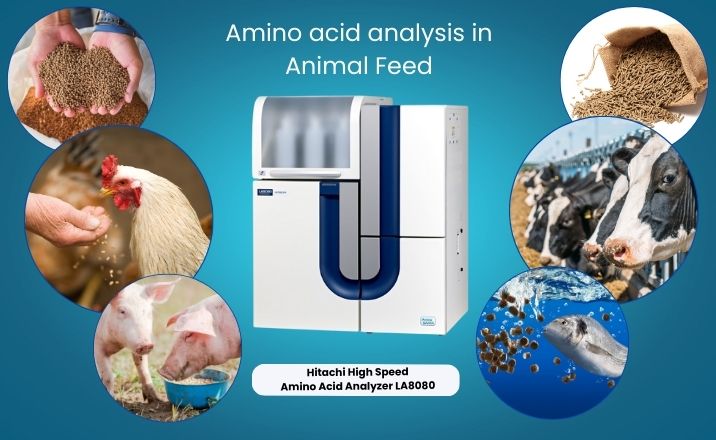
At Envirocare Labs, we apply science to real-world nutrition by using the Hitachi LA8080 Amino Acid Analyzer — a gold-standard tool for high-resolution amino acid analysis. This method provides the reliable data needed for calculating PDCAAS and DIAAS accurately.
Here’s how the process works:
- Hydrolysis
Proteins in the food or supplement are broken down into free amino acids using acid hydrolysis. - Separation
The individual amino acids are then separated using ion-exchange chromatography, which sorts them based on charge and polarity. - Detection
A post-column derivatization step using ninhydrin allows colorimetric detection at 570 nm (for primary AAs) and 440 nm (for imino acids like proline). - Reporting
The resulting amino acid profile is compared to FAO/WHO reference patterns to assess protein quality using PDCAAS or DIAAS.
Why Hitachi LA8080 amino acid analyzer?
- Validated accuracy and reproducibility;
- Complies with Codex, USP, EP, JP, and FSSAI guidelines;
- Ideal for nutritional labeling, R&D, and formulation development;
- Whether you’re testing plant-based proteins, novel food ingredients, or clinical formulations, the LA8080 gives you the confidence of high-resolution, regulatory-compliant data.
Conclusion: Protein Quality Begins with Scientific Precision
In a world where “high protein” is a common label claim, it’s the quality — not just the quantity — that truly matters.
Accurate amino acid analysis reveals:
- The true nutritional value of a protein source
- The limiting amino acids that reduce its biological effectiveness
- How processing, formulation, and blending affect protein utilization
At Envirocare Labs, we go beyond basic testing. Using advanced tools like the Hitachi LA8080 amino acid analyzer, we deliver data that supports evidence-based nutrition, regulatory compliance, and product innovation — helping you make proteins perform.
Because precision in amino acid analysis is the foundation of precision in nutrition.