Your mandatory food nutritional labelling checklist:
14 things every packaged food item must have
A quick checklist for food business operators, startups and D2C brands so your pack carries everything which is mandatory abiding the law before it goes to print.
Getting your food nutritional labelling right is only part of the job. In our earlier guide we decoded what each part of a food label actually means, section by section. (If you have not read it yet, start with Decoding nutritional food labelling: a comprehensive guide.) This piece is the practical companion to it: a checklist you can hold your artwork against before it goes to print.
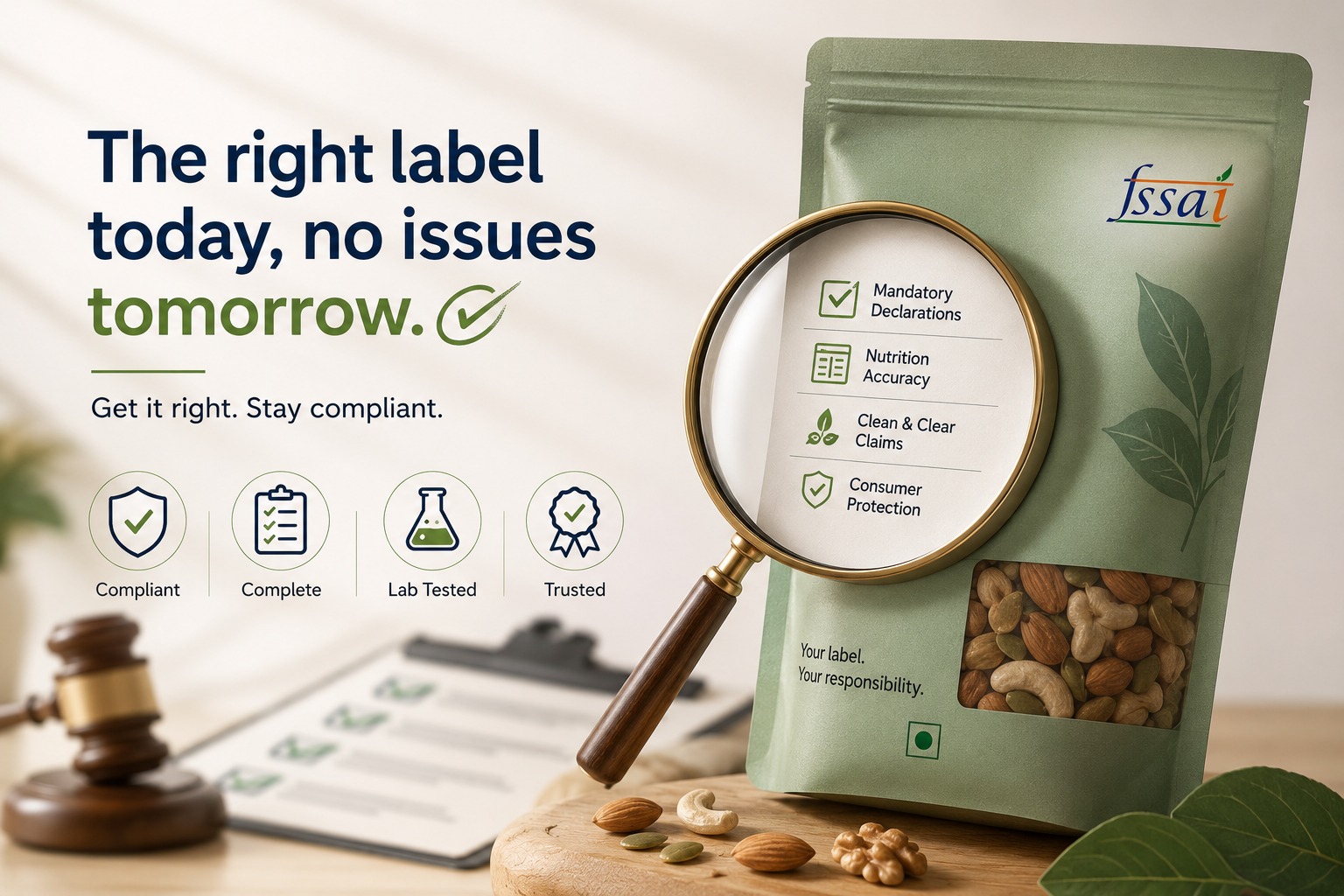
Most founders think of label compliance as one task. In practice your pack sits at the meeting point of two separate rulebooks, and both apply at the same time.
What you must declare on every pack. Mandatory and non-negotiable.
What you may say beyond the requirements. Allowed, but every line needs proof.
This checklist covers the rulebook and the declarations that must be followed before you claim your food product as “high protein” or as “no added sugar.”
The 14-point pre-print checklist

Name of the food item
Use the standardised or category name of the food product and not just your brand name. The consumer should be able to tell what the product is at a glance.

List of ingredients
List ingredients in descending order of their composition by weight or volume at the time of manufacture, under a clear heading. Compound ingredients, if used, should be broken down into individual ingredients when they constitute more than 5 per cent of the final product.

Nutritional information
This is the heart of your food nutritional labelling. It must declare the mandatory nutrients, including Energy, Protein, Carbohydrates (with details of Total Sugars, Added Sugars and Dietary Fibre), Total Fat (including Saturated Fat, Trans Fat and Cholesterol) and Sodium. Additional vitamins and minerals may be declared only if they have been added to the product. Nutritional values should be presented per 100g, per 100ml, or as the per-serving size, along with the percentage contribution to the recommended dietary allowance (RDA).

Veg or non-veg symbol
A filled green circle inside a green square for vegetarian products, and a filled brown mark inside a brown square for non-vegetarian products. The symbol must be clearly visible against the pack.

Food additives declaration
Declare additives by their class name and their INS (International Numbering System) number, so the function and identity of each additive are both clear.

Allergen information
Clearly declare the major allergen groups where present: cereals containing gluten, milk, egg, fish, crustaceans, tree nuts, peanuts, soy and sulphites. Even a minor processing ingredient counts.

Manufacturer, packer or importer details
Full name and complete address of the brand owner. For imported food, the name and complete address of the importer in India must also appear.

FSSAI logo and licence number
The FSSAI logo and licence number of the brand owner shall be displayed on the label. The licence number of the manufacturer or packer, if different from the brand owner, shall also be displayed. For imported products, the importer’s FSSAI logo and licence number must be displayed as per FSSAI guidelines.

Net quantity
Declare the net quantity, and the drained weight where the product is packed in a liquid medium.

Batch, lot or code number
A batch, lot or code number for traceability, so any unit can be traced back to its production run.

Date marking
Date of manufacture or packaging, and the use by / expiry date / best before as applicable to the product, shall be declared on the label.

Country of origin
Mandatory for imported foods. The label must declare the country the food was imported from.

Storage and usage instructions
Include storage, handling and usage instructions wherever the product needs them, for example “refrigerate after opening” or reconstitution steps.

Lab-tested nutritional data
The single point founders skip most often. Your nutritional data should be backed by testing your specific product, not from a similar product’s label. Borrowed values are the fastest route to a claim you cannot defend.
The four mistakes we see most often
Almost every label problem we are asked to review traces back to one of these, and all four are avoidable:
- Copying nutrition data from a competitor’s label instead of testing the actual product.
- Leaving out an allergen because it was only a minor processing ingredient.
- Setting a “best before” date by guesswork rather than a proper shelf-life study.
- Listing ingredients alphabetically instead of by descending weight.
Why these 14 pointers matter most
Every claim on a pack is a measurement waiting to be checked. “High in protein” is a measurement against a threshold. “Best before nine months” is the output of a stability study. If your nutrition panel is borrowed rather than tested, every claim built on it is exposed the moment a food safety officer asks for proof.
The cost of getting it wrong
The burden of proof sits with you, not with FSSAI. If an officer questions a declaration or a claim, you are expected to produce the supporting evidence.
For a bootstrapped brand, a forced recall can wipe out an entire season’s inventory. Increasingly, e-commerce platforms and investors also ask for test reports before they will list or fund you. A full product characterisation panel at an accredited lab is a small, one-time cost spread across every unit you produce, which works out to a few paise per pack.
What makes a lab report defensible
A test result carries regulatory weight only when it comes from the right kind of lab. Look for a lab that is accredited to ISO/IEC 17025:2017 by NABL (the National Accreditation Board for Testing and Calibration Laboratories), a lab which is FSSAI-notified so its reports are admissible in regulatory proceedings, and a lab which uses standardised test methods. A report from such a lab is not just a number; it is the receipt that backs your claim when someone asks for proof.
Make your label bulletproof before you print
Whether you’re launching a new product or updating an existing one, our experts can help you determine the tests your product requires and ensure your label is supported by accurate laboratory data and regulatory requirements.
Food nutritional labelling: common questions
What is food nutritional labelling?
Food nutritional labelling is the declaration of a product’s nutrient content on its pack — energy, protein, carbohydrate, sugars, fat, saturated fat and sodium — so a buyer can see what the food contains. In India it sits within the wider set of mandatory label declarations governed by FSSAI.
Is food nutritional labelling mandatory in India?
Yes. Under FSSAI’s labelling regulations, packaged food sold in India must carry a nutritional information panel. Confirm the exact applicability and any exemptions for your product category against the current FSSAI regulation.
What must the nutrition panel show?
Energy, Protein, Carbohydrates (with details of Total Sugars, Added Sugars and Dietary Fibre), Total Fat (including Saturated Fat, Trans Fat and Cholesterol) and Sodium — typically per 100g or 100ml and per serving, with the percentage contribution to the recommended dietary allowance. Confirm the current required parameters and format against the FSSAI source before printing.
Where should the nutrition values come from?
From testing your specific finished product at an accredited lab, not from a similar product’s label. Borrowed figures are the most common cause of a claim that cannot be defended when an officer asks for proof.